Guided workflow
From topography to a first design in a few steps, cutting chair time and diagnostic lenses.

Custom lenses for highly asymmetric ocular surfaces.
Less chair time, less remakes and better fits —
for the cases that define your reputation.
ENGINEERED FOR COMPLEX FITS.
A look beyondBuilt for your
most complex cases.
LensLab is our design tool for contact lens specialists: an intuitive, highly customizable workspace to resolve asymmetric ocular surfaces, cut fitting time and keep every parameter in your hands.
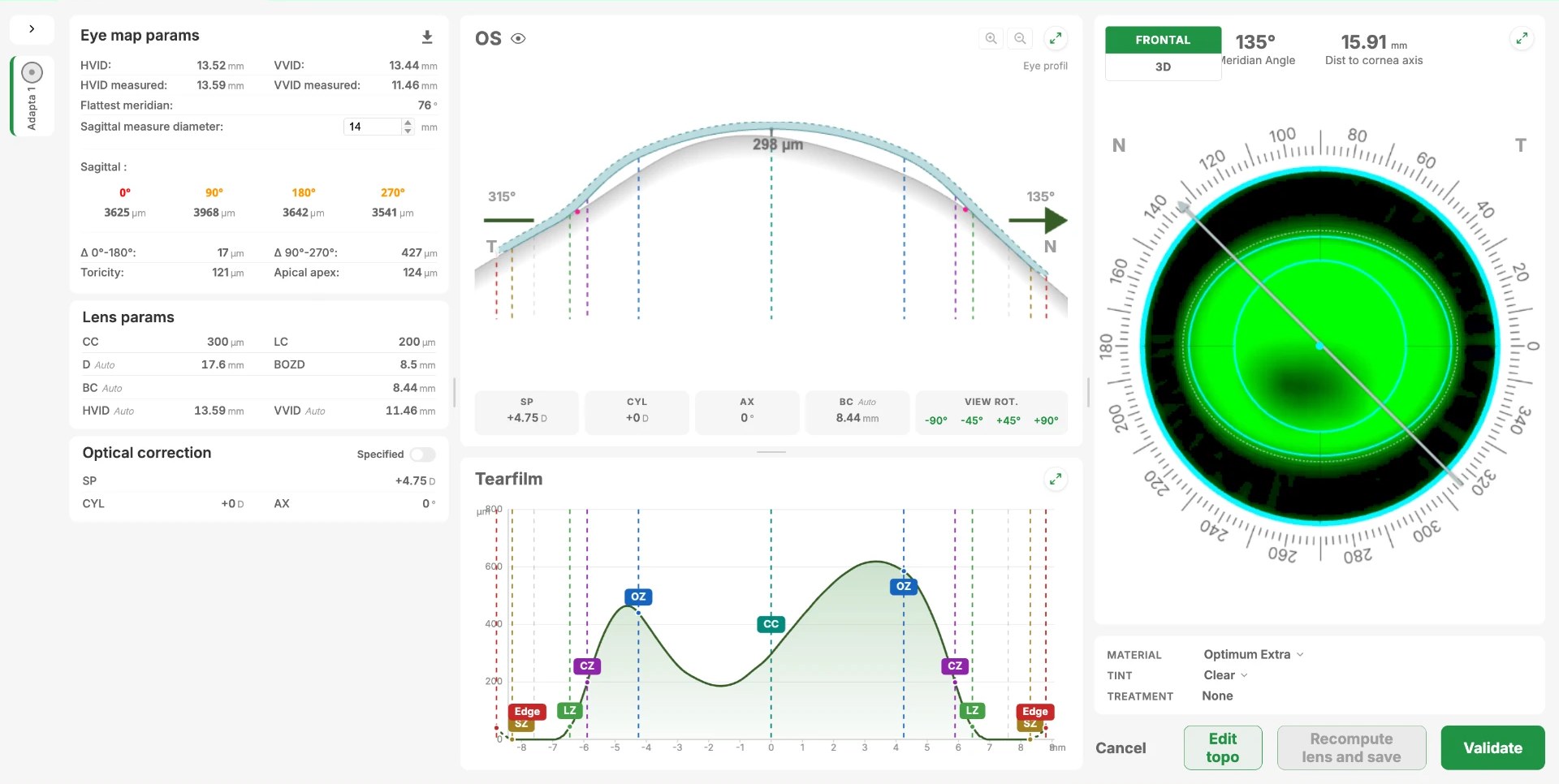
Capture corneal and scleral geometry with your topographer, profilometer or OCT, in the format you already use.
Check map quality and read the real asymmetry of the surface before any design decision is taken.
The map becomes a 3D model of that eye inside LensLab: this surface will be used to design the lens on.
Generate a first freeform design from that model with the parameters you set, instead of starting from a catalogue lens.
Inspect sagittal sections and landing curves point by point to verify clearance, alignment and bearing.
Review the expected fluorescein pattern and look at the 3D representation of the lens on the eye before ordering.
Review the imported surface and the lens built on it as a single 3D model, and check it from any angle before releasing the order.
Send the validated design and its specifications to MedLac laboratories for manufacturing.
When the lens is designed on the real ocular surface from the very first attempt, you need fewer diagnostic lenses and far fewer end up discarded.
From topography to a first design in a few steps, cutting chair time and diagnostic lenses.
Shape the landing curve point by point to match highly asymmetric scleras and corneas.
You review and validate every decision. LensLab supports your expertise; it never replaces it.
Keratoconus, post-graft corneas, pinguecula or irregular scleras: freeform geometry follows the real ocular surface point by point, especially along the landing curves, instead of forcing rotationally symmetric curves onto an asymmetric eye.
A freeform portfolio for irregular corneas and asymmetric scleras, designed to improve first-fit success and patient satisfaction.
 Scleral design
Freeform scleral lens for irregular corneas and highly asymmetric scleral profiles.
 Corneoscleral design
Freeform corneoscleral GP design for irregular and asymmetric corneas and scleras.
 Corneal design
Freeform corneal GP design for irregular and asymmetric corneas.
Documented fittings for keratoconus, post-graft corneas and irregular scleras: the challenge, the point-by-point design and the outcome for the practice.
MedLac Corporation is a group that covers the whole of Europe. Each site is organised to support you in your consultations. Click the site nearest to you and responsible for your area, and request support.